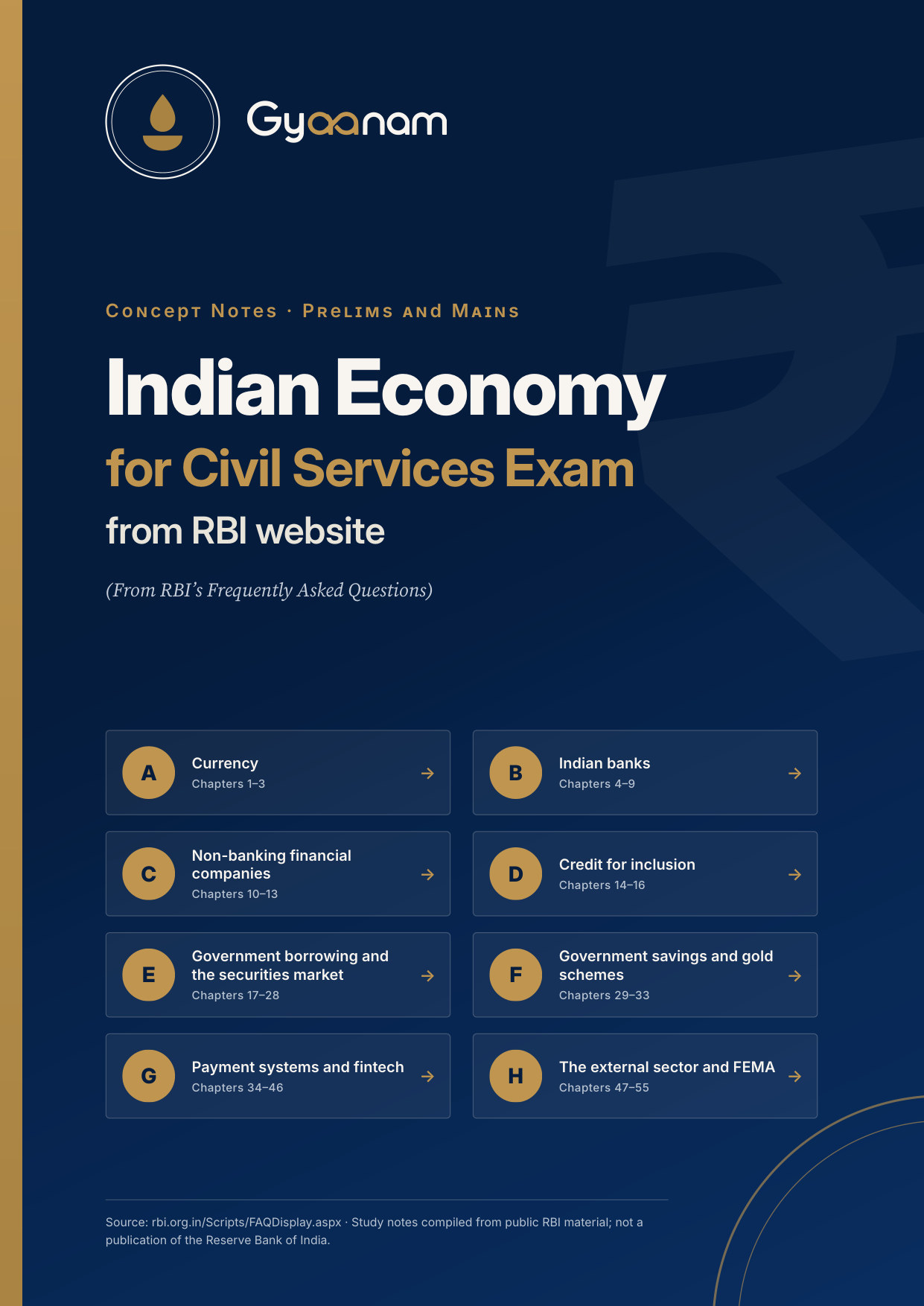
Indian Economy for Civil Services Exam
from RBI website
The Reserve Bank of India answers hundreds of questions on its website: who issues the rupee, how a payments bank is licensed, what a government securities auction is, how UPI reaches Singapore. The answers are written for bank customers and compliance staff, as scattered questions. These notes rearrange that material so it can be learned.
Each chapter moves from the idea to the detail: what the thing is, why it exists, how it works, what the rules and limits are, how it differs from its neighbours, and where a statement-based question is most likely to trip you. Nothing is added from textbooks, news or general knowledge, and every statement was checked against the FAQ it came from.
No account needed. Pay once, download right away, and the link reaches your email.
Sample pages
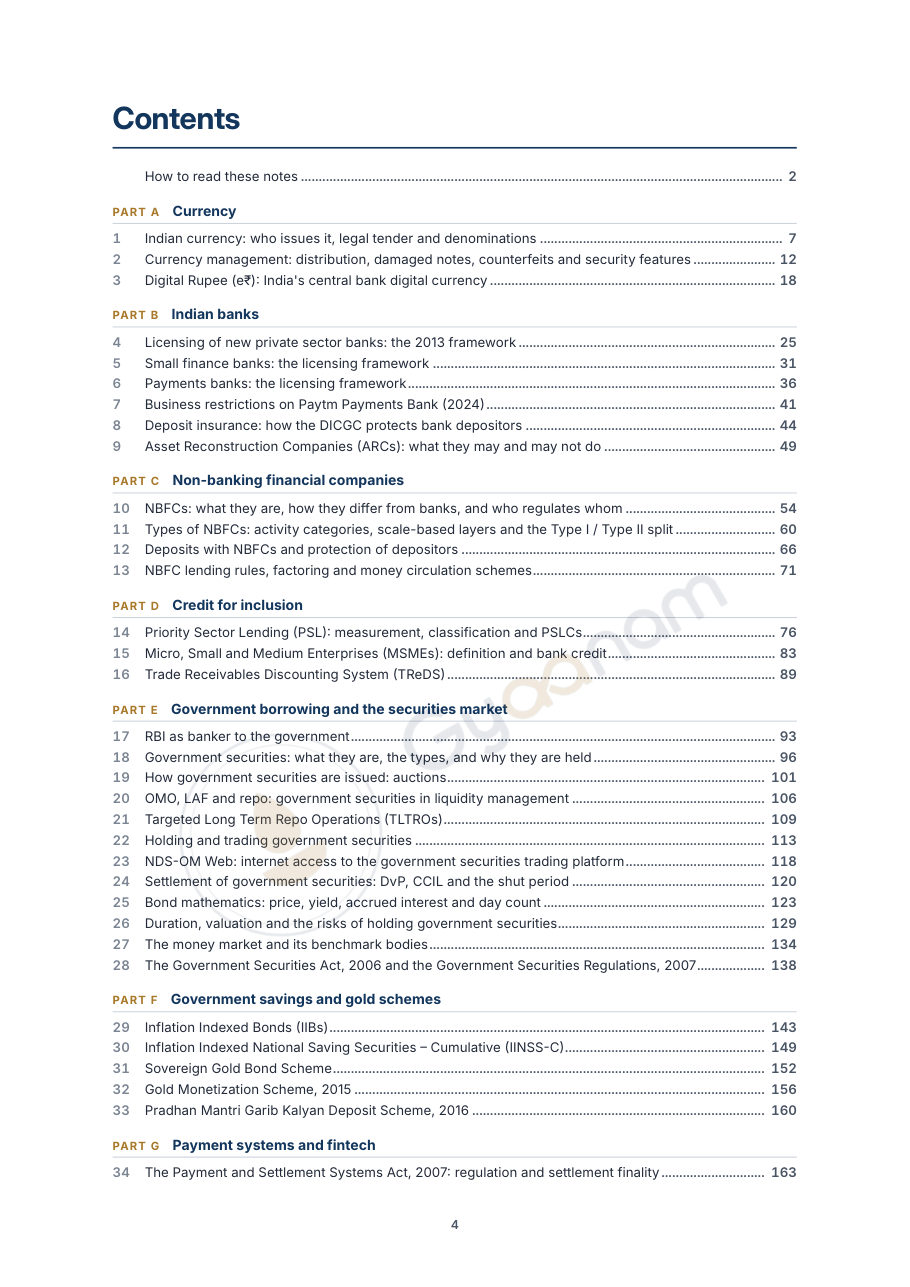
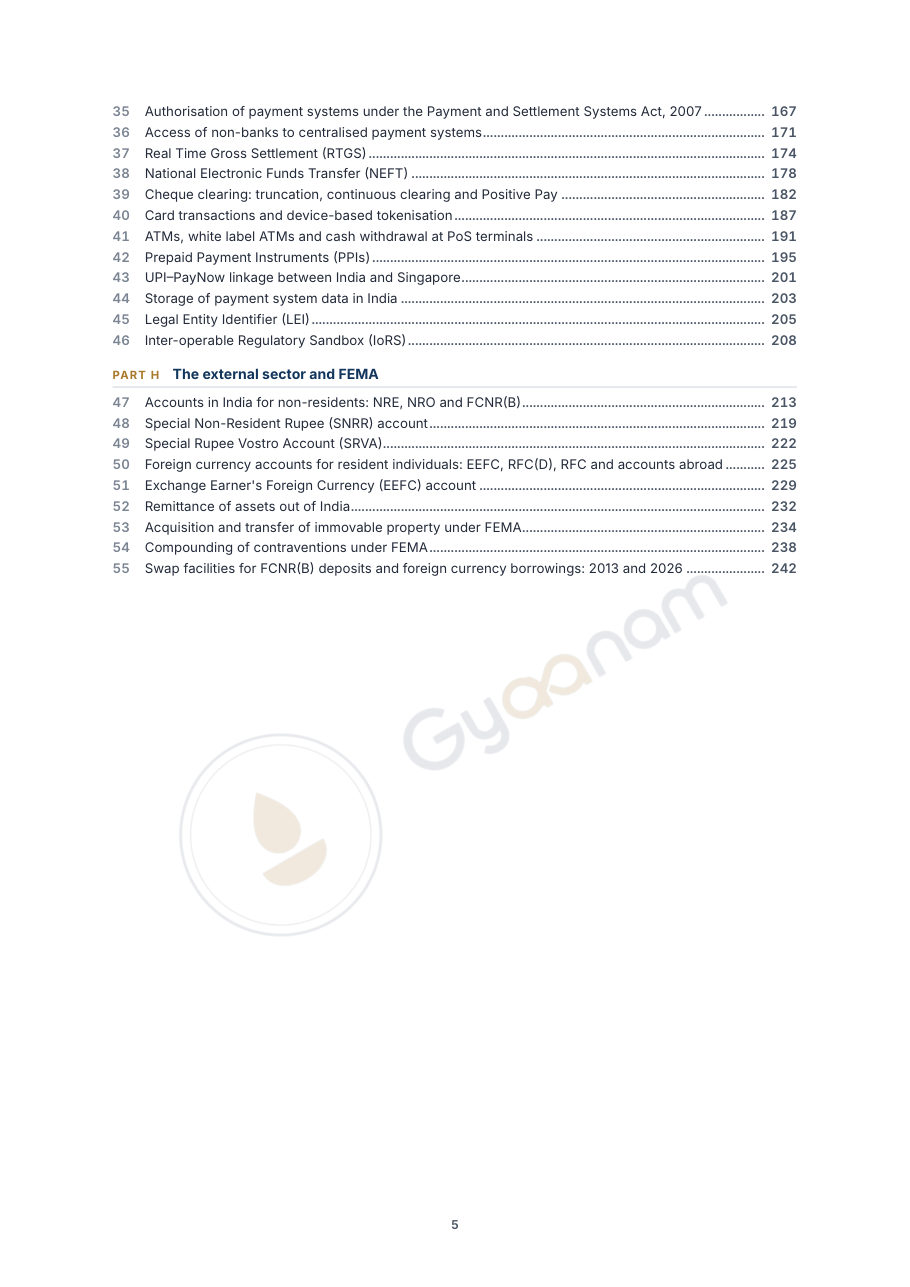
The cover and the contents, as they are in the PDF. Open a page to see it larger, then turn to the next one.
What is inside
55 chapters in 8 parts, in the order the cover shows. Each chapter names the RBI FAQ it is built from and the date RBI gives for it.
PART ACurrency3 chapters
- Indian currency: who issues it, legal tender and denominations
- Currency management: distribution, damaged notes, counterfeits and security features
- Digital Rupee (e₹): India’s central bank digital currency
PART BIndian banks6 chapters
- Licensing of new private sector banks: the 2013 framework
- Small finance banks: the licensing framework
- Payments banks: the licensing framework
- Business restrictions on Paytm Payments Bank (2024)
- Deposit insurance: how the DICGC protects bank depositors
- Asset Reconstruction Companies (ARCs): what they may and may not do
PART CNon-banking financial companies4 chapters
- NBFCs: what they are, how they differ from banks, and who regulates whom
- Types of NBFCs: activity categories, scale-based layers and the Type I / Type II split
- Deposits with NBFCs and protection of depositors
- NBFC lending rules, factoring and money circulation schemes
PART DCredit for inclusion3 chapters
- Priority Sector Lending (PSL): measurement, classification and PSLCs
- Micro, Small and Medium Enterprises (MSMEs): definition and bank credit
- Trade Receivables Discounting System (TReDS)
PART EGovernment borrowing and the securities market12 chapters
- RBI as banker to the government
- Government securities: what they are, the types, and why they are held
- How government securities are issued: auctions
- OMO, LAF and repo: government securities in liquidity management
- Targeted Long Term Repo Operations (TLTROs)
- Holding and trading government securities
- NDS-OM Web: internet access to the government securities trading platform
- Settlement of government securities: DvP, CCIL and the shut period
- Bond mathematics: price, yield, accrued interest and day count
- Duration, valuation and the risks of holding government securities
- The money market and its benchmark bodies
- The Government Securities Act, 2006 and the Government Securities Regulations, 2007
PART FGovernment savings and gold schemes5 chapters
- Inflation Indexed Bonds (IIBs)
- Inflation Indexed National Saving Securities – Cumulative (IINSS-C)
- Sovereign Gold Bond Scheme
- Gold Monetization Scheme, 2015
- Pradhan Mantri Garib Kalyan Deposit Scheme, 2016
PART GPayment systems and fintech13 chapters
- The Payment and Settlement Systems Act, 2007: regulation and settlement finality
- Authorisation of payment systems under the Payment and Settlement Systems Act, 2007
- Access of non-banks to centralised payment systems
- Real Time Gross Settlement (RTGS)
- National Electronic Funds Transfer (NEFT)
- Cheque clearing: truncation, continuous clearing and Positive Pay
- Card transactions and device-based tokenisation
- ATMs, white label ATMs and cash withdrawal at PoS terminals
- Prepaid Payment Instruments (PPIs)
- UPI–PayNow linkage between India and Singapore
- Storage of payment system data in India
- Legal Entity Identifier (LEI)
- Inter-operable Regulatory Sandbox (IoRS)
PART HThe external sector and FEMA9 chapters
- Accounts in India for non-residents: NRE, NRO and FCNR(B)
- Special Non-Resident Rupee (SNRR) account
- Special Rupee Vostro Account (SRVA)
- Foreign currency accounts for resident individuals: EEFC, RFC(D), RFC and accounts abroad
- Exchange Earner’s Foreign Currency (EEFC) account
- Remittance of assets out of India
- Acquisition and transfer of immovable property under FEMA
- Compounding of contraventions under FEMA
- Swap facilities for FCNR(B) deposits and foreign currency borrowings: 2013 and 2026
The daily edition, every morning by 9 AM.
The news decoded for the exam, prelims pointers, and the Daily Quiz. Nothing to pay when you sign up.